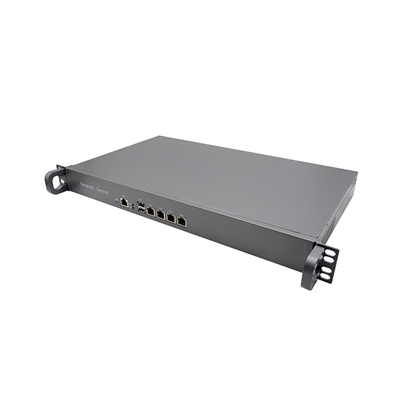
As industrial networks become increasingly connected, protecting industrial systems from network threats has become an important part of modern infrastructure. A 1U industrial firewall provides a compact hardware solution for industrial network security while fitting into standard rack-mounted environments.
However, different industrial applications have different requirements. Before selecting an industrial firewall, users should consider several key factors.
1. Check the Network Interfaces
Network interfaces are one of the first factors to consider when choosing industrial firewall hardware.
Depending on the network architecture, an industrial firewall may require multiple Gigabit Ethernet ports, 2.5G or 10G network ports, or SFP interfaces for fiber connections. Multiple LAN ports can also help separate different network zones, such as production networks, management networks, and external networks.
Choosing the right port configuration ensures that the firewall can meet both current network requirements and future expansion needs.
2. Consider Processing Performance
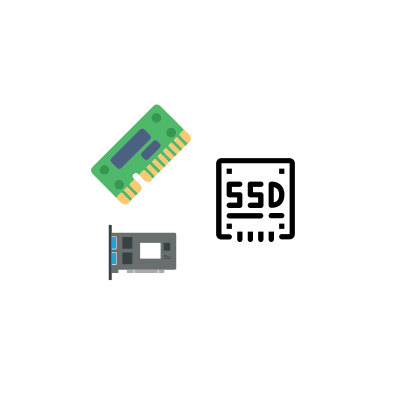
Firewall performance is closely related to the processor, memory, storage, and overall hardware architecture.
For industrial networks with multiple connections and high traffic volumes, a firewall with sufficient processing capability can help maintain stable network communication. The hardware should be selected according to the expected traffic load and security requirements rather than simply choosing the highest-performance processor.
For applications such as industrial automation, edge computing, and network appliances, stable long-term processing performance is particularly important.
3. Evaluate Industrial Reliability
Industrial environments can be more demanding than ordinary office or commercial environments. Temperature changes, continuous operation, electrical interference, and limited maintenance access can all affect equipment reliability.
When selecting an industrial firewall, consider specifications such as operating temperature, component quality, cooling design, PCB design, and overall system stability.
A reliable hardware platform can help support continuous operation in industrial control cabinets, factories, and other demanding environments.
4. Pay Attention to Power Supply Design
Power supply design is another important consideration for industrial network security equipment.
Depending on the application, a 1U industrial firewall may support DC power input, redundant power supplies, or dual power configurations. Redundant power options can provide additional protection for applications where network availability is important.
Before purchasing, users should check the required input voltage and whether the firewall supports the power architecture of the target system.
5. Look at Expansion and Customization Options
Industrial projects often have different hardware requirements. Some applications may require additional LAN ports, SFP interfaces, storage, wireless connectivity, or other expansion options.
For OEM and system integration projects, customizable industrial firewall hardware can provide greater flexibility. The processor, memory, storage, network interfaces, and power configuration can be selected according to the application.
This is particularly useful when the firewall needs to be integrated into a customized industrial network system.
6. Consider the 1U Rack-Mount Design
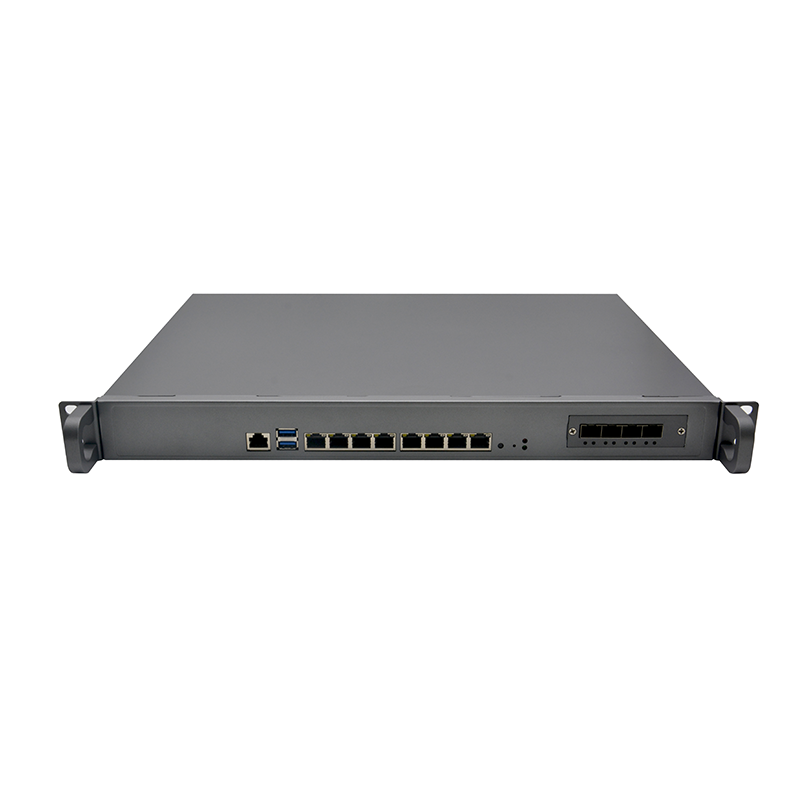
The main advantage of a 1U industrial firewall is its compact rack-mount form factor.
A 1U design can be installed in standard network cabinets while reducing the space required for industrial network equipment. It is suitable for applications such as industrial control rooms, factory networks, network security systems, edge computing, and communication cabinets.
Users should also check the firewall‘s dimensions, mounting method, cooling structure, and power supply location before installation.
7. Match the Firewall to the Application
The right industrial firewall should be selected according to the actual network environment.
For example, a factory network may require multiple LAN ports and reliable continuous operation, while an edge computing application may place greater emphasis on processing performance and high-speed network interfaces.
Therefore, instead of focusing on a single specification, users should evaluate the complete hardware configuration and its compatibility with the target network.
Conclusion
Choosing a 1U industrial firewall involves more than comparing the number of network ports. Processing performance, network interfaces, industrial reliability, power supply design, expansion options, and rack compatibility should all be considered.
For industrial automation, factory networks, edge computing, and industrial network security applications, selecting the right industrial firewall hardware can provide a reliable foundation for long-term network deployment.
A well-configured 1U industrial firewall can combine compact rack-mount installation with flexible network connectivity, making it a practical solution for modern industrial network security.






 WhatsApp

 Teamas
